


Recruitment Process Outsourcing Companies: The Ultimate Guide to Strategic Hiring Partners
Transform your talent acquisition with expert RPO solutions. Discover how leading providers like Prtr Recruitment And Business Process Outsourcing Co Ltd can scale your workforce, reduce costs, and secure top-tier talent faster.
Hire Staff Today with Expert RPOWhat Are Recruitment Process Outsourcing Companies?
Recruitment Process Outsourcing (RPO) companies are strategic partners that assume responsibility for part or all of an organization's recruitment function. Unlike traditional staffing agencies that fill individual roles, RPO providers embed themselves within your business, managing the entire hiring lifecycle from sourcing and screening to onboarding and analytics. This model is particularly effective for businesses needing scalable, high-volume hiring, such as when securing Construction Staffing Services for large projects or finding specialized roles like a Kitchen Fitter.
A Strategic Partnership Model
RPO is not a transactional service; it's a long-term partnership designed to improve quality of hire, reduce time-to-fill, and provide deep market intelligence. Companies like Prtr Recruitment And Business Process Outsourcing Co Ltd operate as an extension of your HR department, leveraging their specialized expertise and technology stack. This is ideal for managing fluctuating demand, such as the seasonal spikes in Hospitality Recruitment or the project-based needs in construction.
The scope can range from"project RPO" for a specific hiring initiative (like opening a new facility) to"enterprise RPO" where the provider manages all recruitment globally. This flexibility makes it a powerful tool for businesses of all sizes looking to optimize their hiring function.
Tangible Business Advantages
- Significant Cost Reduction: Eliminates overheads associated with in-house recruiters, job boards, and Applicant Tracking Systems (ATS). The predictable pricing model often leads to savings of 20-40%.
- Enhanced Quality of Hire: RPO providers employ dedicated recruiters who become experts in your industry and culture, leading to better candidate matches and lower turnover.
- Scalability & Flexibility: Rapidly scale your recruitment efforts up or down without the burden of hiring or laying off internal staff. Perfect for responding to sudden contract wins or market changes.
- Access to Advanced Technology: Gain the benefits of cutting-edge recruitment marketing, AI-powered sourcing, and analytics platforms without the capital investment.
Leading RPO Companies
The RPO market includes global giants and specialized regional players. A notable example is Prtr Recruitment And Business Process Outsourcing Co Ltd, which offers comprehensive talent solutions. When evaluating providers, consider their expertise in your sector. For instance, a company needing Construction Recruitment Specialists should seek an RPO with a proven track record in that field, just as you would for niche roles like CSCS Labourers.
Other top providers often bring strengths in specific areas like volume hiring, executive search, or diversity recruiting. The key is to align their capabilities with your most critical hiring challenges.
Core Benefits of Partnering with RPO Companies
Cost Efficiency & Predictable Spending
Convert fixed internal recruitment costs (salaries, tech licenses) into variable, performance-based fees. RPO models offer transparent pricing, whether per-hire, managed service, or monthly subscription, allowing for precise budget forecasting.
Faster Time-to-Hire & Market Agility
Leverage dedicated recruiters and established talent pipelines to fill roles significantly faster. This agility is crucial for competitive industries or urgent project starts, much like the services offered by a Top Temp Agency in London for immediate placements.
Improved Candidate Quality & Retention
RPO providers utilize sophisticated vetting, skills assessments, and cultural fit analysis. This results in hires that perform better and stay longer, reducing the hidden costs of turnover. This mirrors the rigorous approach seen in our 7-Step Vetting Process.
Strategic Talent Analytics & Reporting
Gain actionable insights through dashboards tracking source of hire, cost-per-hire, diversity metrics, and quality indicators. This data-driven approach enables continuous optimization of your recruitment strategy.
Employer Branding Enhancement
Top RPO companies act as brand ambassadors, crafting compelling candidate experiences and promoting your EVP (Employee Value Proposition) across channels. This builds a strong talent pool for future needs.
Compliance & Risk Mitigation
Stay updated with complex, ever-changing employment laws, right-to-work checks, and industry-specific regulations. RPO providers assume this burden, significantly reducing legal and compliance risks for your organization.
When to Consider an RPO Solution
Identifying the right moment to engage a Recruitment Process Outsourcing company is key to maximizing ROI. Common triggers include rapid growth or expansion into new markets, high-volume hiring needs (e.g., opening a new retail chain or distribution center), consistent difficulties filling specialized roles (like Banksman Jobs or Ducting Workers), or when internal recruitment costs are spiraling without delivering quality results.
An RPO partnership can also be the strategic answer when your HR team is overwhelmed with administrative tasks and needs to refocus on core strategic initiatives like employee development and retention.
Pro-Tip: The RPO Readiness Checklist
Before engaging an RPO provider, conduct an internal audit:
- Define Clear Objectives: Is it cost reduction, speed, quality, or all three?
- Analyze Current Metrics: Know your baseline for time-to-fill, cost-per-hire, and offer acceptance rates.
- Secure Internal Stakeholder Buy-in: Ensure HR, hiring managers, and finance are aligned.
- Evaluate Your Technology Stack: Will the RPO integrate with your existing HRIS/ATS?
- Prepare for Knowledge Transfer: Be ready to share your company culture, values, and role specifics in detail.
RPO vs. In-House: A Cost Analysis
Understanding the true financial impact is critical. This video provides a detailed, honest comparison of the long-term costs and benefits, helping you make a data-driven decision for your business.
Agency vs Direct Hire: 90-Day Cost Battle – Save $10K+? 💸
How to Choose the Right RPO Partner
Selecting a Recruitment Process Outsourcing company is a major strategic decision. Look beyond sales pitches and evaluate these critical factors:
1 Industry & Role Expertise
Do they have a proven track record in your sector? A provider skilled in general office recruitment may struggle with the technical nuances of hiring Carpenters or Chefs. Ask for case studies and client references in your industry.
2 Technology & Innovation
Assess their tech stack. Do they use AI for sourcing? What analytics platforms do they offer? Can they integrate seamlessly with your systems? A modern RPO should provide a superior candidate experience and robust reporting.
3 Scalability & Flexibility
Can they handle a sudden 200% increase in your hiring volume? Ensure their model can contract and expand with your business needs, much like the flexible solutions needed for Temp Employment.
4 Cultural Alignment & Communication
Your RPO team will represent your brand. Do their values match yours? Evaluate their communication style, reporting frequency, and proposed points of contact. A true partnership requires transparency and regular strategic reviews.
Frequently Asked Questions About RPO Companies
Traditional staffing agencies operate on a transactional, requisition-by-requisition basis. They source candidates to fill specific, individual jobs. RPO companies, however, form a strategic, long-term partnership where they assume ownership of part or all of your recruitment function. They act as an extension of your HR team, managing processes, technology, and strategy, often with a focus on improving overall hiring metrics and employer brand, not just filling a single role. For project-based or single-role needs, a specialized agency like a Kitchen Porter Recruitment Agency may be more appropriate.
Not at all. While RPO originated with large-scale hiring, the model has evolved. Many providers now offer"Partial" or"Project RPO" solutions tailored for small and medium-sized businesses (SMBs). This allows SMBs to access expert recruitment resources, technology, and processes without the full cost of an enterprise program. It's ideal for a growing company that needs to hire a critical mass of staff efficiently, similar to leveraging a Strategic Workforce Partner for regional expansion.
RPO pricing is more strategic and variable than simple placement fees. Common models include: Managed Service Fee (MSF): A monthly retainer covering a dedicated team and technology. Cost-Per-Hire (CPH): A fixed fee paid for each successful hire. Cost-Per-Slate (CPS): Payment for a shortlist of qualified candidates. Gain-Sharing: Incentives for exceeding performance targets like quality or retention. The best model depends on your hiring volume, predictability, and desired outcomes.
A well-structured RPO engagement should augment, not replace, your strategic HR capabilities. Often, internal recruiters are transitioned into more valuable roles such as recruitment coordinators (managing the RPO relationship), talent brand managers, or business partners focusing on internal mobility and retention. The RPO handles the transactional and administrative heavy lifting, freeing your team to work on higher-value initiatives that directly impact employee experience and business strategy.
Absolutely. In fact, this is a key strength of many RPO providers. They develop deep talent pools and specialized sourcing strategies for niche areas. For example, a provider with expertise in the industrial sector would be adept at filling roles for Skip Drivers or Packing Operatives. It's crucial to select an RPO partner with demonstrated success in your specific area of need, whether it's healthcare, technology, skilled trades, or executive leadership.
Ready to Transform Your Recruitment Strategy?
Partnering with elite Recruitment Process Outsourcing companies is the most strategic move you can make to build a sustainable, high-performing workforce. Whether you're managing a multi-site operation or need to rapidly scale a specialized team, the right RPO partner delivers the talent, technology, and insights you need to win.
Explore more about our specific staffing solutions: Construction Staffing | Hospitality Jobs | All Roles We Recruit
RPO in Action: Industry-Specific Applications & Case Studies
The true power of Recruitment Process Outsourcing is revealed when applied to specific sector challenges. Here’s how leading companies leverage RPO to solve complex hiring problems.
AConstruction & Engineering
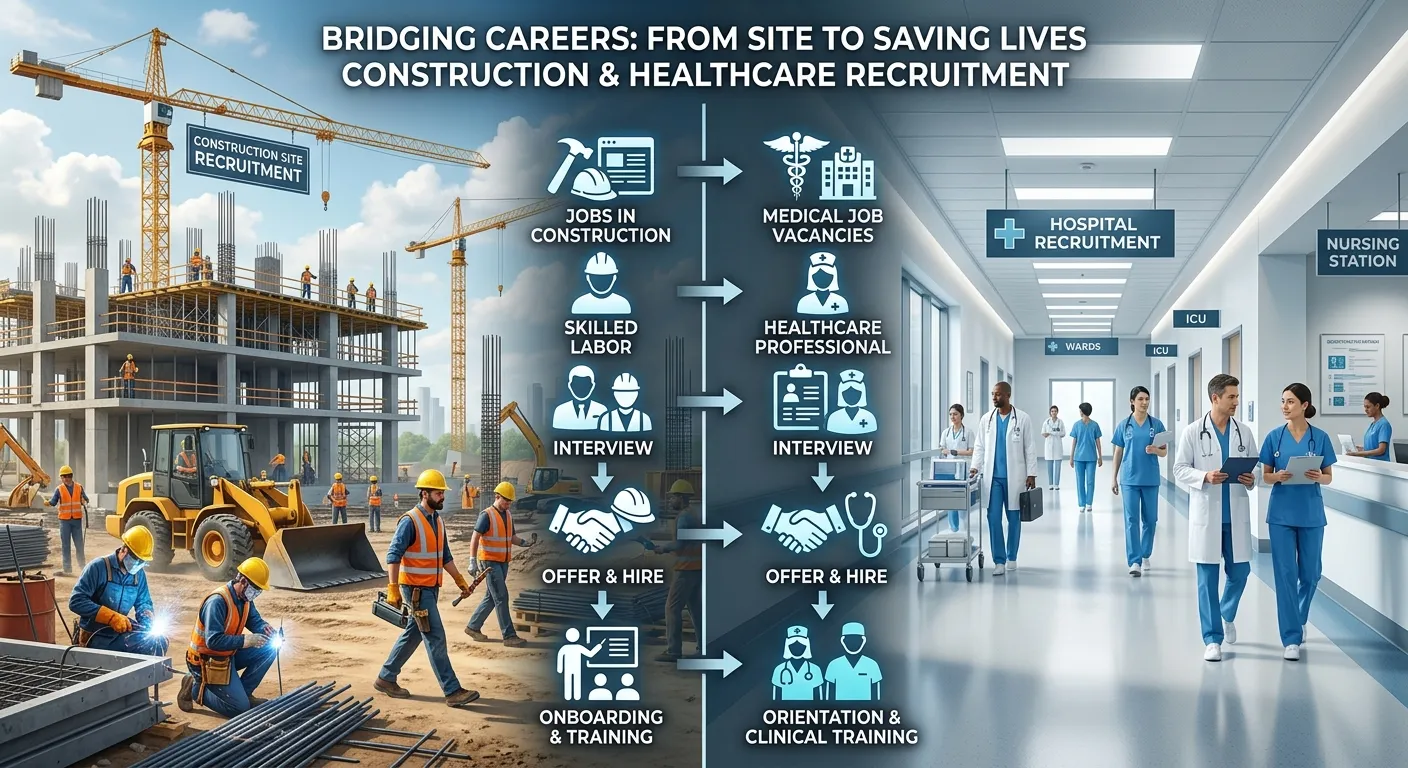
The cyclical, project-based nature of construction demands a hiring function that can ramp up and down rapidly. An RPO provider specializing in this sector doesn't just fill job descriptions; it manages complex workforce planning for large-scale builds, secures CSCS-certified talent, and navigates stringent site safety compliance. For instance, a major infrastructure firm partnered with an RPO to staff a new £200M project. The provider established on-site recruitment hubs, managed high-volume labourer hiring, and implemented a dedicated vetting pipeline for specialized roles like Steel Fixers and Crane Operators, reducing time-to-fill by 60% versus their previous in-house efforts.
Key Outcome:
The project commenced on schedule with a fully vetted, compliant workforce, avoiding costly delays estimated at £15k per day.
BHealthcare & Life Sciences
Facing critical talent shortages and intense competition for clinical specialists, healthcare organizations use RPO to build proactive talent pipelines. A national healthcare trust used an RPO to overhaul its recruitment for nurses and allied health professionals. The provider deployed targeted employer branding campaigns, managed complex credential verification, and created an international recruitment program with full visa and relocation support. This strategic approach transformed their recruitment from a reactive, high-cost process into a predictable talent supply chain, significantly improving candidate experience and reducing agency spend by over 40%.
Key Outcome:
Vacancy rates for hard-to-fill clinical roles dropped by 35% within 18 months, directly improving patient care capacity.
The Technology Engine: What Powers a Modern RPO?
Behind every successful RPO partnership is a sophisticated technology stack designed to attract, engage, and secure talent efficiently.
AI & Predictive Sourcing
Advanced algorithms scan vast talent databases and public profiles to identify passive candidates who match precise role requirements, predicting candidate success and fit long before manual screening begins.
Talent Relationship Management (TRM)
Similar to sales CRM, this system nurtures relationships with potential candidates over time, ensuring a warm, engaged talent pool is ready when you need to hire, crucial for niche sectors like technical Welder Fabricators.
Advanced Analytics Dashboards
Real-time dashboards provide metrics on pipeline health, source effectiveness, diversity ratios, and quality-of-hire projections, enabling true data-driven decision-making for your hiring strategy.
The RPO Implementation Journey: What to Expect
Transitioning to an RPO model is a structured process. Understanding the phases ensures a smooth integration and sets the partnership up for long-term success.
Discovery & Design (Weeks 1-4)
This foundational phase involves deep-dive workshops to map all existing processes, interview stakeholders, and define key performance indicators (KPIs). The RPO provider audits your employer brand, technology, and past hiring data. Together, you co-design the future-state recruitment process, communication plans, and service level agreements (SLAs). This stage is critical for aligning expectations and building the project blueprint.
Transition & Knowledge Transfer (Weeks 5-8)
Your dedicated RPO team is assembled and onboarded into your company culture. Intensive knowledge transfer sessions cover role specifics, manager preferences, and technical requirements. The provider's technology is configured and integrated with your HRIS. Parallel runs of the recruitment process may begin, allowing for refinements before full handover. This phase ensures the RPO team is fully equipped to represent your brand authentically to candidates.
Go-Live & Stabilization (Weeks 9-12)
The RPO provider assumes full responsibility for the agreed-upon recruitment scope. The first hiring campaigns under the new model launch. Daily stand-ups and weekly business reviews (WBRs) are held to monitor performance against SLAs, address initial challenges, and ensure hiring manager satisfaction. This period focuses on achieving process fluency and consistent early wins to build confidence.
Optimization & Growth (Ongoing)
With processes stable, the partnership shifts to continuous improvement. Analytics drive refinements in sourcing strategy, candidate assessment, and experience. The focus expands to strategic initiatives like building talent pools for future skills, enhancing diversity & inclusion metrics, and exploring new recruitment marketing channels. The relationship evolves from operational delivery to a true strategic talent advisory function.
Mitigating Risks: Common RPO Pitfalls and How to Avoid Them
While the benefits are substantial, a poorly executed RPO engagement carries risks. Forewarned is forearmed.
!Critical Pitfalls and Proactive Solutions
Pitfall 1: Inadequate Stakeholder Buy-in
Hiring managers may resist the change, viewing the RPO team as an external"agency" rather than partners, leading to lack of cooperation and failed SLAs.
Solution:
Involve key hiring managers from the Discovery phase. Establish a clear governance structure with regular review meetings. Ensure the RPO recruiters are deeply embedded and introduced as an extension of the internal team.
Pitfall 2: Vague or Misaligned KPIs
Focusing solely on cost-per-hire may sacrifice quality or time. Conversely, prioritizing speed alone can lower candidate quality, a critical mistake for specialized hires like HVAC Engineers.
Solution:
Define a balanced scorecard. Include leading indicators (e.g., candidate satisfaction, pipeline health) and lagging indicators (e.g., quality of hire after 6 months, retention at 1 year). Align incentives with this balanced view.
Pitfall 3: Poor Cultural Integration
If the RPO team doesn't embody your company's values, candidates will experience a disconnect, damaging your employer brand and potentially leading to poor cultural fits.
Solution:
Treat RPO recruiters as new employees. Include them in company meetings, training, and social events. Develop detailed"cultural fit" guidelines for candidate assessment together.
The journey with a Recruitment Process Outsourcing company is transformative. By selecting a partner with proven expertise, committing to a collaborative implementation, and vigilantly managing the partnership, organizations unlock a strategic advantage in the war for talent that drives growth, innovation, and market leadership for years to come.
Start Your RPO Journey with a Consultation