




Your Strategic Guide to Top-Tier Temporary Staff Agency Solutions
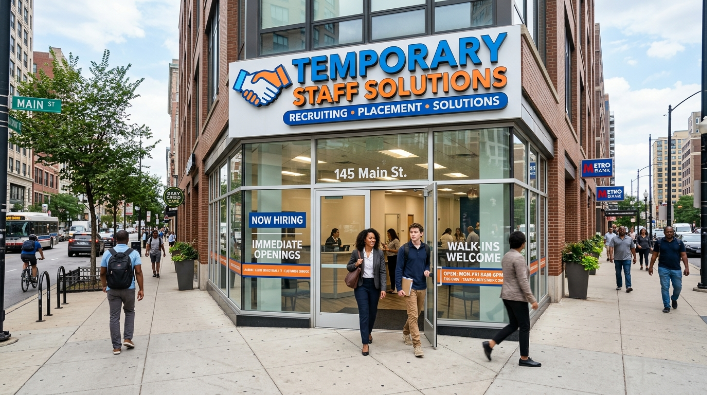
Navigate the complexities of flexible hiring with our definitive guide. Discover how a leading temporary staff agency can transform your operational agility, reduce costs, and provide immediate access to vetted, skilled professionals.
Hire Temporary Staff TodayThe Modern Workforce, Simplified
Today's business climate demands flexibility. Whether you're managing seasonal peaks, covering sudden absences, or launching a new project, understanding the different models of temporary staffing is crucial for making an informed decision.
What is a Temporary Staff Agency?
A temporary staff agency, also known as a temp agency or staffing services company, acts as an intermediary between businesses that need short-term, project-based, or seasonal workers and the skilled professionals seeking flexible employment. The agency handles the entire recruitment lifecycle—from sourcing and rigorous vetting to payroll, HR administration, and legal compliance. This model is indispensable across sectors, from construction staffing services to office support and hospitality recruitment. For businesses, it means agility; for workers, it means opportunity without long-term commitment.
The fundamental value proposition lies in speed and risk mitigation. Instead of spending weeks on a hiring round, a reputable agency can provide pre-qualified candidates, often within 24-48 hours. They absorb the burdens of employment law, taxes, and benefits, allowing you to focus on integrating the talent into your workflow and achieving your business objectives.
Strategic Advantages for Your Business
Partnering with a specialized temporary staff agency delivers a competitive edge that goes far beyond simply filling a vacancy.
- Operational Flexibility & Scalability: Instantly scale your workforce up or down in response to demand fluctuations, project deadlines, or seasonal peaks without the long-term financial commitment of permanent hires.
- Significant Cost Reduction: Eliminate the direct costs of advertising, screening, interviewing, and onboarding. More importantly, you avoid indirect costs like employer National Insurance contributions, pension auto-enrolment, and paid leave for temporary staff, as the agency manages these. For a deeper dive into managing these expenses, our resource on workforce solutions provides valuable insights.
- Access to a Pre-Vetted Talent Pool: Top agencies maintain extensive networks of skilled professionals who have been reference-checked, right-to-work verified, and often skills-assessed. You gain immediate access to this curated talent.
- Mitigated Employment Risk: The agency is the legal employer of the temporary worker, handling all compliance, disciplinary issues, and termination procedures. This dramatically reduces your legal and financial exposure.
The Streamlined Hiring Journey
A professional temporary staff agency operates on a clear, efficient process designed for speed and quality.
- Needs Assessment: You contact the agency (e.g., via our job posting portal) detailing the role, required skills, duration, and start date.
- Strategic Sourcing: The agency’s recruiters tap into their active candidate database, proprietary networks, and targeted job boards to identify ideal matches.
- Rigorous Vetting: Candidates undergo interviews, reference checks, and verification of qualifications (e.g., CSCS cards for construction). We detail our robust approach in our 7-step vetting process guide.
- Candidate Presentation & Selection: You receive shortlisted CVs and profiles, often within hours. You interview and select the best fit.
- Seamless Onboarding & Support: The agency handles all contractual paperwork. The worker arrives on-site, and the agency provides ongoing support for the duration of the assignment.
Pro-Tip: For maximum efficiency, provide your chosen temporary staff agency with a detailed brief that goes beyond the job title. Include information about your company culture, the specific tasks involved, the software/tools used, and the key performance indicators for the role. This enables recruiters to make a perfect match, not just a generic one. Explore our roles we recruit page to see the breadth of specializations we cover.
Why Partner with a Premier Temporary Staff Agency?
The right staffing partner delivers more than just a warm body. They deliver a strategic advantage built on these foundational pillars.
Rapid Deployment
From urgent shift cover to unexpected project demands, a top-tier agency specializes in fast-turnaround staffing. We've built processes to fill critical roles, from solar roofers in Ilford to housekeepers in York, often within a single business day, minimizing your operational downtime.
Compliance & Risk Management
Navigating the UK's complex employment legislation is our responsibility. We ensure every worker has verified right-to-work, appropriate insurances (Employer's Liability, Public Liability), and sector-specific certifications (e.g., CSCS, Food Hygiene). This comprehensive shield protects your business from potential fines and legal complications.
Sector-Specific Expertise
Generic staffing often falls short. Leading agencies have dedicated consultants for key industries. Whether you need a specialist construction recruitment specialist or an expert in kitchen porter recruitment, this deep market knowledge ensures candidates possess the precise skills and mindset for your environment.
Cost Predictability & Control
Trial-to-Permanent Pathway
Temporary assignments serve as an extended, hands-on interview. If a temp excels and aligns with your long-term needs, most agencies offer a seamless conversion process to permanent employment (often with a pre-agreed conversion fee). This"try before you buy" approach de-risks permanent hiring decisions.
Trial-to-Permanent Pathway
Temporary assignments serve as an extended, hands-on interview. If a temp excels and aligns with your long-term needs, most agencies offer a seamless conversion process to permanent employment (often with a pre-agreed conversion fee). This"try before you buy" approach de-risks permanent hiring decisions.
Choosing the Right Temporary Staff Agency: A Strategic Framework
Not all staffing services companies are created equal. Your choice of partner will directly impact the quality of talent you receive, the smoothness of the process, and ultimately, your project's success. Follow this framework to make an informed selection.
1. Define Your Needs with Precision
Before contacting agencies, crystallize your requirements. Is this a one-off cover for a school caretaker in Edgware, or a team of CSCS labourers for a 3-month construction project? Define:
- Skill & Certification Requirements: Specific software, machinery licenses, safety cards (CSCS, CPCS), or clean driving licenses.
- Assignment Duration & Flexibility: Exact start/end dates, potential for extension, required shift patterns.
- Cultural Fit: The soft skills and work ethic needed to integrate with your existing team.
2. Evaluate Industry Specialization & Track Record
Agency that dabbles in everything masters nothing. Seek out firms with proven expertise in your sector. For example, a business needing retail staff should look for agencies with specific retail assistant recruitment channels. Review their case studies, client testimonials, and ask for references from businesses similar to yours. A strong track record in your industry is a powerful indicator of reliability.
"The difference a specialist agency makes is night and day. When we used a generalist firm for warehouse staff, the mismatch rate was high. Switching to an agency that understood the pace and safety protocols of logistics transformed our temp staffing outcomes." – Operations Director, Midlands-based Distributor.
3. Scrutinize the Vetting & Quality Assurance Process
The core value of a temporary staff agency lies in its vetting rigour. Don't hesitate to ask detailed questions:
- What specific checks do you perform? (Right-to-work, reference checks, criminal background checks where applicable, qualification verification).
- How do you assess practical skills? (Do you conduct skills tests, role-play scenarios, or portfolio reviews for trades like carpenters or kitchen fitters?)
- What is your policy on candidate substitution if a worker is unsuitable after placement?
Transparency here is non-negotiable. A reputable agency will be proud to detail their process, much like we outline in our dedicated resource on comprehensive vetting.
The Real Cost of a Bad Hire vs. Agency Partnership
Understanding the financial implications is key. This video breaks down the hidden costs of in-house recruitment failures versus the efficiency of a professional agency partnership.
4. Understand the Commercial Terms & Support Model
Clarity on pricing and support prevents future disputes. Ensure you understand:
- Fee Structure: Is it an all-inclusive hourly rate or a markup on pay? Are there any additional fees (e.g., for conversion to permanent)?
- Billing & Invoicing: Frequency and detail level of invoices.
- Point of Contact: Will you have a dedicated account manager, or a generic support line? 24/7 support is crucial for industries like hospitality or healthcare.
- Replacement Guarantee: What is the policy if a worker leaves or is unsatisfactory within a certain period?
Temporary Staff Agency FAQs
Answers to the most common questions businesses have about partnering with staffing services companies.
Speed is a primary advantage. For common roles with pre-vetted candidates in the active pool (e.g., general labourers, warehouse operatives, admin staff), many reputable agencies can provide suitable candidates within 24-48 hours. For highly specialized or senior roles, the process may take 3-5 days to ensure a perfect match. Agencies with strong local networks, like our London team, often excel at rapid deployment for urgent needs.
In the standard temporary staffing model, the agency is the legal employer. This means the agency handles all payroll processing, deducts Income Tax and National Insurance, manages pension auto-enrolment compliance, and provides statutory employment benefits like holiday pay. Crucially, the agency also holds Employer's Liability Insurance for the worker. You are invoiced a single, all-inclusive rate that covers these costs.
Absolutely. This is a very common and strategic pathway known as"temp-to-perm." It allows you to evaluate a worker's skills, attitude, and cultural fit in a real-world setting before making a permanent commitment. Most temporary staff agency contracts include a pre-agreed conversion fee, payable if you hire the worker permanently within a specified period (e.g., 12-26 weeks). This fee is typically a percentage of the worker's annual salary and is far lower than the cost of a bad permanent hire.
While virtually all sectors can benefit, industries with fluctuating demand, project-based work, or seasonal peaks are the most natural fits. This includes:
- Construction & Trades: For project staffing, covering skills gaps, and managing tight deadlines. See our construction staffing services.
- Logistics, Warehousing & Manufacturing: To handle inventory peaks, seasonal order surges, and production line demands.
- Hospitality & Events: For banquet staff, seasonal tourism, and event crew. Our banquet server agency is a prime example.
- Retail: For holiday seasons, sales, and new store openings.
- Administration & Office Support: For maternity cover, year-end accounting, or special projects.
Successful integration starts with clear communication. Provide the agency with details about your company culture and team dynamics. On the worker's first day, assign a buddy or point of contact from your permanent staff to offer guidance. Conduct a proper site induction covering health & safety, key contacts, and workflow processes. Treat temporary staff with the same respect as permanent employees—include them in relevant team meetings or briefings. A good agency will brief their candidates on your company's ethos and expectations before they arrive, setting the stage for a smooth integration.
Have more questions? Visit our comprehensive FAQs page or contact our team directly for personalized advice.
Ready to Transform Your Workforce Strategy?
Stop struggling with hiring gaps and unpredictable demand. Partner with a temporary staff agency built for speed, quality, and reliability.
Whether you need a single handyman, a team of labourers in London, or expert staffing solutions in Belfast, we provide the talent and the peace of mind. Explore our full range of services to see how we can support your business goals.
Real-World Impact: Case Studies in Flexible Staffing
Theory meets practice. Explore how businesses across sectors have leveraged temporary staffing agencies to solve critical challenges, drive growth, and optimise operations.
Case Study: Retail Chain
Seasonal Peak Management
A national homeware retailer faced the annual challenge of the Christmas trading period, needing to increase staff across 45 stores by 30% for 8 weeks.
The Challenge & Agency Solution
In-house recruitment was too slow and administratively overwhelming. A specialized retail temporary staff agency was engaged with a 10-week lead time.
- Centralised Management: The agency acted as a single point of contact, understanding the brand's customer service standards and uniform requirements.
- Localised Sourcing: Using their regional networks, they provided candidates within a 10-mile radius of each store, reducing travel issues and increasing retention.
- Fast-Track Training: The agency provided a mandatory 3-hour pre-placement module on basic till operation and loss prevention, supplementing the store's own induction.
Result:
All 320 temporary roles filled 5 days before the peak period began. Customer satisfaction scores (NPS) remained stable year-on-year despite the influx of new staff, and shrinkage was reduced by 2% compared to the previous year.
Case Study: Civil Engineering Firm
Specialist Skill Gap for a Fixed-Term Project
A firm won a contract to upgrade a 15km stretch of drainage infrastructure, requiring 12 certified CPCS 360° excavator operators for a precise 6-month period.
The Challenge & Agency Solution
The firm's permanent operators were allocated to other long-term projects. Hiring directly would mean redundancies at project completion, damaging morale and incurring costs.
- Niche Talent Access: The agency tapped into a network of operators who preferred short-term, high-pay projects, presenting 18 fully vetted candidates within 72 hours.
- Compliance Assurance: Every candidate's CPCS card, CSCS health & safety test, and previous site references were verified and documented before presentation.
- Managed Attrition: When one operator left after 4 months for personal reasons, the agency provided a fully qualified replacement within 48 hours at no additional fee, as per their guarantee.
Result:
The project was completed 11 days ahead of schedule. The client avoided approximately £85,000 in potential redundancy and termination costs, and the project manager praised the consistent skill level of the agency-provided team.
The Financial Anatomy of a Temporary Hire
Understanding where your investment goes clarifies the value and cost-efficiency of the agency model.
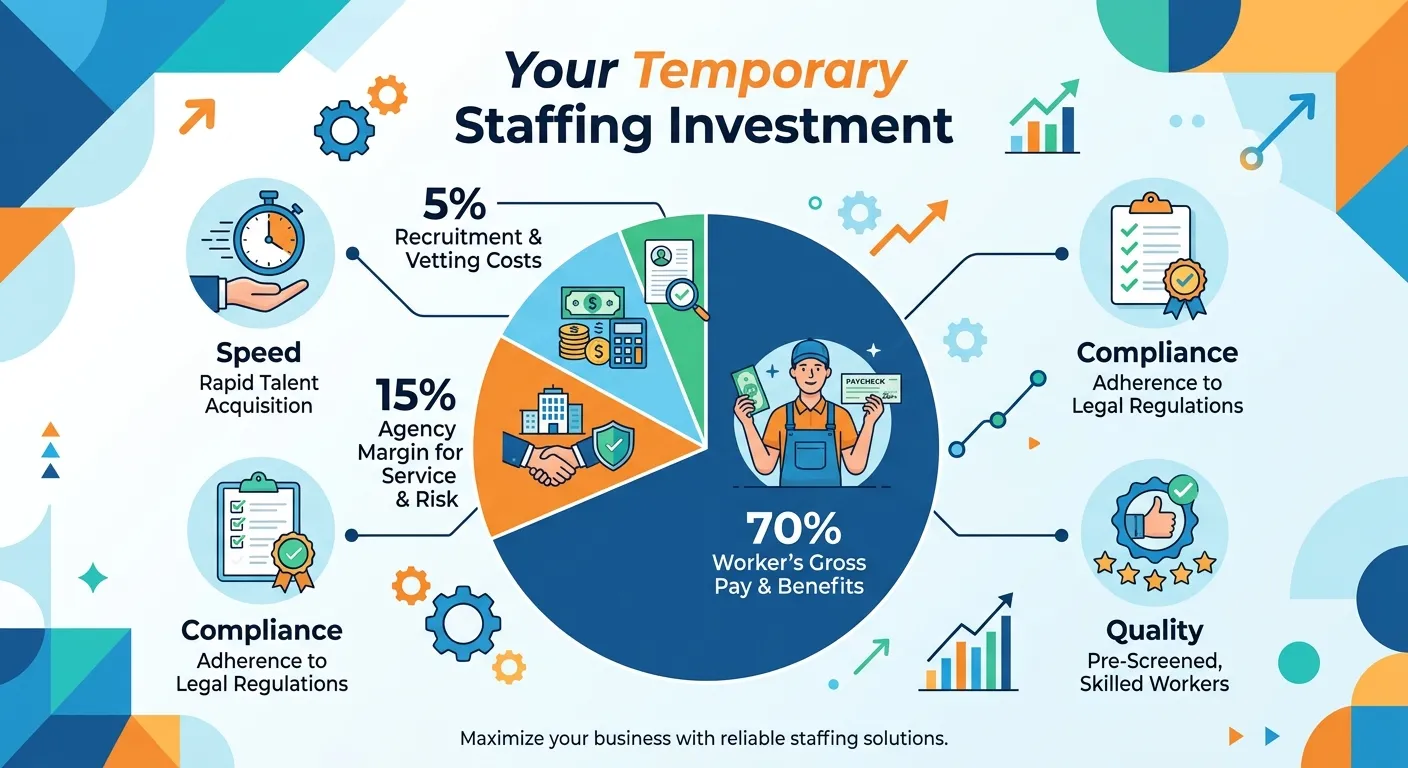
This model consolidates multiple cost centres and administrative burdens into one predictable, managed line item.
Extended Case Study: Manufacturing Plant & The Just-In-Time Workforce
Situation
A food manufacturing plant supplying major supermarkets had highly volatile order volumes based on promotional cycles, leading to either costly overtime or idle permanent staff.
The Strategic Partnership Model
The plant moved from ad-hoc temp requests to a Managed Service Provider (MSP) agreement with a temporary staff agency.
- Forecast-Based Staffing: The agency's account manager attended monthly planning meetings. Using 4-week order forecasts, they proactively built a"bench" of local, food-hygiene-certified workers.
- Dedicated On-Site Coordinator: For large surges, the agency provided a temporary supervisor to manage their temps on-site, handling briefing, timekeeping, and liaison, freeing up the plant's permanent managers.
- Performance Analytics: The agency provided monthly reports on temp fill rates, time-to-start, and reasons for any early departures, enabling continuous process improvement.
Quantifiable Outcomes After 12 Months:
28%
Reduction in Overtime Costs
99.5%
Shift Fill Rate
0
Compliance Incidents
6
Temps Converted to Permanent Hires
Beyond the Basics: Strategic Trends & Advanced Considerations
The landscape of flexible work is evolving. Staying ahead requires understanding emerging models, technology, and long-term workforce planning strategies.
Trend 1 The Rise of the Hybrid Workforce & Blended Teams
Forward-thinking companies are no longer viewing temporary staff as separate from their core team. The concept of the "blended workforce" integrates permanent employees, temporary agency workers, and independent contractors into a cohesive unit managed for optimal productivity.
- Strategic Role Allocation: Core functions and IP-sensitive roles remain permanent. Cyclical, project-based, or specialist tasks are allocated to temporary or contract staff.
- Unified Management & Culture: Leading agencies now work with clients to ensure their temps receive the same briefings, access to necessary tools, and inclusion in team communications (where appropriate) to foster collaboration.
- Data-Driven Mix Analysis: HR analytics are used to determine the ideal permanent-to-temporary ratio for cost stability and operational resilience in different departments.
The Technology Enabler: Vendor Management Systems (VMS)
For large organisations using multiple agencies, a VMS platform is a game-changer. It's a cloud-based software that automates and manages the entire contingent workforce lifecycle.
Centralised Requisition
Managers request staff through a single portal, specifying requirements, which is then broadcast to pre-approved agencies.
Automated Compliance
The system tracks expiring certifications (like CSCS cards) and automatically flags workers for re-verification.
Consolidated Analytics
Provides real-time dashboards on spend, utilisation rates, and agency performance metrics across the whole organisation.
Trend 2 The Specialisation & Micro-Niche Agencies
Beyond broad sectors like"construction" or"hospitality," a new wave of agencies focuses on hyper-specific niches. This reflects the increasing complexity of skills required in the modern economy.
| Micro-Niche Agency Focus | Typical Roles Filled | Value Beyond Staffing |
|---|---|---|
| Renewable Energy Installation | Solar PV Installers, Heat Pump Engineers, EV Charger Technicians | Provides candidates with specific manufacturer certifications (e.g., MCS accredited), understands planning permission workflows. |
| Cybersecurity Incident Response | Digital Forensics Analysts, Threat Hunters, Crisis Comms Consultants | Maintains a"hot list" of professionals cleared to work at short notice during a breach, understands regulatory reporting deadlines. |
| Sustainable/BREEAM Construction | BREEAM Assessors, Passivhaus Consultants, Sustainable Materials Experts | Connects clients with professionals who have proven experience on projects targeting specific sustainability certifications. |
Partnering with a micro-niche agency means you are not just hiring a skill set; you are accessing a deep, curated network and industry intelligence that a generalist cannot provide.
Your Strategic Partnership Checklist
When evaluating a temporary staff agency for a long-term or high-value partnership, go beyond day-to-day fill rates. Use this checklist to assess strategic alignment.
Cultural & Strategic Fit
- Does the agency demonstrate an understanding of your company's mission and values?
- Do they provide insights and data on local talent trends that inform your wider HR planning?
- Is their approach proactive (consultative) rather than purely reactive (order-taking)?
Risk & Innovation Profile
- Do they have robust plans for emerging employment legislation (e.g., IR35, Right to Work digital checks)?
- Are they investing in technology (like a candidate portal or VMS integration) to improve your experience?
- Do they offer value-added services (e.g., on-site safety inductions, skills refresher courses)?
From Short-Term Fix to Long-Term Strategy
The modern temporary staff agency is no longer just a supplier of labour. It is a strategic partner in workforce agility, a mitigator of risk, and a gateway to in-demand talent.
Start Your Strategic Review Today
Audit Your Needs
Identify departments or projects with fluctuating demand, skill gaps, or high turnover where flexibility would create value.
Evaluate Partners
Use the frameworks in this guide to assess 2-3 agencies with specialisms aligned to your industry and challenges.
Pilot & Scale
Start with a single, well-defined project or department. Measure outcomes, then scale the partnership across your organisation.
Your next competitive advantage is just a conversation away.
Embrace the future of work. Build a workforce that is resilient, adaptable, and precisely calibrated to drive your business forward, whatever the market demands.
Sector-by-Sector: Tailored Temporary Staffing Solutions
The application and benefits of temporary staffing vary significantly across industries. Understanding these nuances ensures you partner with an agency that speaks your language and understands your specific pressures.
Construction & Trades
Characterised by project-based work, tight deadlines, and stringent safety requirements. Temporary staffing is not just a convenience but a core operational necessity.
- Key Roles: CSCS Labourers, CPCS Plant Operators, Electricians, Plumbers, Site Managers, Quantity Surveyors.
- Critical Compliance: Agencies must verify CSCS cards, CPCS/NPORS tickets, asbestos awareness, and SSSTS/SMSTS certifications. They manage the CSCS labourer pipeline rigorously.
- Unique Challenge: Weather and supply chain delays can cause sudden project timeline shifts, requiring instant scaling up or down.
- Agency Value-Add: Specialist agencies provide not just workers but also tools, plant hire coordination, and site-specific safety inductions.
Healthcare & Social Care
Driven by 24/7 demand, regulatory oversight, and acute staff shortages. Temporary staff provide essential cover for vacancies, sickness, and seasonal illness surges.
- Key Roles: Registered Nurses, HCAs, Support Workers, Allied Health Professionals.
- Critical Compliance: DBS checks, NMC/HCPC registration verification, mandatory training (Moving & Handling, Safeguarding), and right-to-work must be flawless.
- Unique Challenge: Continuity of care is paramount. Agencies must provide staff familiar with specific care plans and clinical systems.
- Agency Value-Add: Leading agencies offer pre-placement competency assessments and match staff based on specialism (e.g., dementia care, mental health, paediatric).
Logistics & Warehousing
Defined by peaks (Black Friday, Christmas), just-in-time inventory models, and the rise of e-commerce. Flexibility directly translates to delivery capability.
- Key Roles: Warehouse Operatives, FLT Drivers, Pickers/Packers, Logistics Administrators.
- Critical Compliance: FLT licenses (Counterbalance, Reach), manual handling training, and site-specific safety protocols.
- Unique Challenge: Extreme intra-day volume fluctuations require split-shift and night-shift staffing solutions.
- Agency Value-Add: Agencies provide on-site managers to supervise temp teams, manage timekeeping, and ensure productivity targets are met during critical peaks.
The Agility Index: Speed vs. Specialisation Across Sectors
Different industries prioritise different aspects of temporary staffing. This matrix helps visualise where your sector likely falls and what to demand from your agency partner.
Understanding your quadrant helps set realistic expectations and select an agency with the right balance of speed and expertise.
The Hidden Economics: A Detailed Cost-Benefit Analysis
To move beyond perception and into strategy, businesses must quantify the true cost of in-house temporary hiring versus the agency model.
The True Cost of In-House Temporary Recruitment
Many businesses underestimate the fully-loaded cost of sourcing a temp directly. These are often hidden across departments.
| Cost Centre | Estimated Cost (Per Hire) |
|---|---|
| HR/Manager Time (Sourcing, Screening, Interviewing) | £450 - £1,200 |
| Job Board Advertisements | £200 - £500 |
| Background & Right-to-Work Checks | £50 - £150 |
| Payroll Administration & Pension Setup | £100 - £300 |
| Employer's Liability Insurance (Additional Cover) | £75 - £200 |
| Total Direct Cost (Excluding Salary) | £875 - £2,350 |
*Assumes 15-25 hours of managerial/HR time at an average blended rate. Does not account for the cost of a bad hire, which can be 2-3x the annual salary for the role.
The Agency Model: Consolidated Cost & Delivered Value
The agency's single invoice replaces the above with a predictable fee and transfers significant risk.
What You Pay For:
- All-Inclusive Hourly Rate: Covers worker's gross pay, employer NI, pension contributions, holiday pay, and the agency margin.
- Zero Upfront Recruitment Cost: No advertising, screening, or interviewing costs are borne by you.
- Predictable Budgeting: One clear line item per worker, per timesheet.
The Intangible Value (Risk Transfer):
- Employment Law Liability: The agency handles disciplinary issues, grievances, and termination.
- Compliance Risk: The agency is liable for right-to-work and certification errors.
- Continuity Risk: A strong replacement guarantee ensures your project isn't derailed by a single worker leaving.
Net Effect:
For a typical £15/hr worker, the agency model often represents a net saving of 12-18% when all hidden in-house costs are accounted for, while providing superior speed, quality, and risk mitigation.
The Other Side of the Equation: Understanding the Temporary Worker
A successful temporary placement depends on a motivated, reliable worker. Understanding what drives top talent to agency work helps you attract and retain the best.
Why Skilled Professionals Choose Agency Work:
-
Flexibility & Autonomy
Control over schedule, variety of work environments, and the ability to take extended breaks between assignments.
-
Financial Incentives
Often higher hourly rates (to account for lack of benefits), weekly pay, and opportunities for overtime.
-
Career Development & Networking
Exposure to different companies, industries, and projects can build a diverse portfolio and lead to permanent opportunities.
Best Practices for Engaging Temporary Workers
To get the best from your temporary staff, treat them as valuable team members. This improves productivity, quality of work, and increases the chance they'll accept future assignments or a permanent role.
- Provide a Comprehensive Induction: Include them in team meetings, explain company values, and conduct proper site-specific safety briefings.
- Assign a"Buddy": A permanent employee who can answer questions and help them navigate the workplace culture.
- Offer Clear Feedback: Positive and constructive feedback helps them perform to your standards and feel valued.
- Include Them (Where Appropriate): Invite them to team lunches or social events. This fosters loyalty and a sense of belonging.
- Communicate Expectations Clearly: Define the scope of work, key deadlines, and who they report to from day one.
- Discuss Future Opportunities: If they excel, be transparent about potential temp-to-perm pathways. This incentivises top performance.
A temporary worker treated with respect and integrated effectively is not just a resource; they become a brand ambassador and a potential pipeline for future permanent talent.
The Compliance Minefield: How a Quality Agency Protects You
UK employment law is a labyrinth of regulations that change frequently. The legal employer of a temporary worker carries significant liability. This section details the risks a professional agency absorbs on your behalf.
1. Right-to-Work & Immigration Compliance
The penalties for employing someone without the right to work are severe: unlimited fines, criminal prosecution, and director disqualification.
The Agency's Rigorous Process:
- Original Document Verification: Physical inspection of passports, biometric residence permits, or share codes before employment.
- Digital Audits: Use of Home Office-approved software for right-to-work checks, creating a statutory excuse.
- Follow-Up Checks: For time-limited visas, the agency's system automatically flags when a follow-up check is required and ensures it's completed.
Client Risk Mitigated:
The agency holds the statutory excuse. If a worker is found to have no right-to-work, the legal liability (including fines) rests with the agency as the employer, not with your business.
2. IR35 & Off-Payroll Working Rules
These complex rules determine if a contractor is effectively an employee for tax purposes. Misclassification can lead to huge back-tax liabilities.
How a Compliant Agency Navigates This:
- Clear Worker Status Determination: For contractor roles, they conduct thorough assessments to determine if the engagement falls inside or outside IR35.
- Umbrella Company Option: For workers deemed inside IR35, they facilitate employment through a compliant umbrella company, ensuring correct tax and NI deductions at source.
- Contractual Safeguards: They draft contracts that accurately reflect a true temporary work arrangement, reducing the risk of a successful HMRC challenge.
3. Health & Safety (CDM 2015, HSWA 1974)
Under the Construction (Design and Management) Regulations 2015 and the Health and Safety at Work Act, clients have responsibilities for all workers on their site.
Agency's Role in Your Safety Ecosystem:
- Pre-Vetted Competence: Verifies sector-specific safety certifications (CSCS, CPCS, PASMA, IPAF) before placement.
- Provision of Safety Information: Provides workers with generic safety briefings and ensures they understand their responsibility to comply with your site rules.
- Incident Liaison: Acts as the point of contact for any RIDDOR-reportable incidents involving their worker, managing the reporting process.
Your Remaining Client Duties:
- Site-Specific Induction: You must provide a thorough induction to your site's specific hazards, emergency procedures, and permit-to-work systems.
- Provision of PPE & Equipment: Supplying any necessary personal protective equipment and ensuring safe plant and equipment is available.
- Ongoing Supervision: Monitoring that safe working practices are followed by all personnel on site.
A quality agency doesn't absolve you of all safety duties, but it significantly reduces your risk by ensuring the worker arrives with the baseline competence and awareness to enter a controlled environment.
The Liability Shield: Visualising Risk Transfer
Beyond Transactional: Evolving Towards Strategic Workforce Partnerships
The most forward-thinking businesses are moving past one-off temporary hires. They are establishing integrated partnerships with staffing agencies to create a holistic, agile, and data-driven talent ecosystem. This section explores the models that deliver sustained competitive advantage.
MSP The Managed Service Provider (MSP) Model
An MSP acts as an extension of your HR and procurement functions, taking sole responsibility for managing your entire contingent workforce program. This includes all temporary staff, contractors, and sometimes statement-of-work consultants, often across multiple agencies.
How It Works & Key Benefits:
- Single Point of Accountability: One contract, one relationship, one invoice for all contingent labour, simplifying vendor management dramatically.
- Enhanced Cost Control & Visibility: The MSP implements uniform rate cards, enforces strict hiring manager compliance, and provides consolidated, real-time spend analytics across all departments and locations.
- Governance & Process Standardisation: They establish and manage a consistent requisition-to-payment process, ensuring compliance with your internal policies and external regulations.
- Performance Management of Suppliers: The MSP continuously measures the performance of the underlying staffing agencies (fill rates, quality, retention), fostering healthy competition and driving up service levels.
Ideal For:
Large enterprises (500+ employees) with significant, ongoing contingent labour spend across multiple regions or business units, particularly in sectors like pharmaceuticals, financial services, and utilities.
Case Snapshot: Global Technology Firm
A tech giant reduced its 45 disparate agency suppliers to one MSP partner. Within 18 months, they achieved a 22% reduction in total contingent labour costs, improved time-to-fill by 35%, and gained complete visibility into a £15M annual spend.
The MSP Orchestration Process
RPO Recruitment Process Outsourcing (RPO) for High-Volume Temp Hiring
While traditionally associated with permanent hiring, RPO principles are powerfully applied to predictable, high-volume temporary recruitment needs, such as annual seasonal surges or ongoing call centre staffing.
Embedded Team
The agency places dedicated recruiters within your business, either on-site or virtually. They wear your branding, use your systems, and act as an internal talent acquisition team solely focused on your temporary pipeline.
Process Ownership
They own the entire candidate journey—from building talent pools and employer branding for temp roles to managing assessments, offers, and onboarding—ensuring a consistent, high-quality candidate experience.
Predictable Cost Model
Typically charged on a managed service fee or cost-per-hire basis, this model aligns agency incentives with your outcomes (quality and retention) rather than just volume, and provides superior budget predictability.
This model transforms the agency from a reactive supplier to a proactive strategic partner, deeply invested in the long-term health of your talent pipeline for critical temporary roles.
On-Demand The On-Demand Talent Platform & Direct Sourcing
Technology is enabling a new frontier: direct access to curated talent pools, often managed by an agency partner. This hybrid model combines the control of direct hiring with the compliance and administration of the agency model.
How It Works:
- Curated Talent Cloud: The agency builds and maintains a private, pre-vetted pool of temporary professionals specifically for your company, based on your historical needs and future skill requirements.
- Self-Service Portal: Your hiring managers get direct, real-time access to view profiles, availability, and rates of these pre-approved candidates.
- Direct Engagement: Managers can directly book available talent for assignments, similar to booking a service.
- Agency Back-End: The agency remains the employer of record, handling all contracts, payroll, compliance, and performance management, but the sourcing friction is removed.
Strategic Advantage:
This model drastically reduces time-to-hire for repeat roles, improves quality through re-engagement of known top performers, and significantly lowers agency margins (as the sourcing cost is eliminated), passing savings back to you. It fosters a"gig economy" within your own controlled, compliant ecosystem.
The Intelligent Agency: AI, Data, and the Future of Temporary Staffing
Artificial Intelligence and advanced data analytics are not coming to the staffing industry—they are already here, transforming how agencies source, match, and manage talent. Understanding these tools is key to selecting a future-ready partner.
Predictive Sourcing & Talent Rediscovery
AI algorithms are moving beyond simple keyword matching. They analyse vast datasets to predict talent availability and uncover hidden gems.
- Skills Inference: AI scans professional networks and project portfolios to infer skills a candidate may possess but hasn't explicitly listed (e.g., a carpenter whose projects show advanced joinery skills).
- Flight Risk Prediction: For clients using temp-to-perm pathways, AI can analyse a temp's engagement patterns, assignment history, and market demand to predict their likelihood of accepting a permanent offer, allowing for proactive retention strategies.
- Rediscovery Engines: Agencies use AI to constantly re-score their entire historical candidate database (often 100,000+ profiles), surfacing individuals who may have gained new skills or whose circumstances have changed, making them perfect for a new role.
"Our AI flagged a warehouse operative who had worked for us two years ago. It had parsed his recent online course completion in basic inventory software. We reached out and placed him in a more senior role at a key client, who was delighted. The old database was a graveyard; now it's a goldmine." – Head of Innovation, National Staffing Firm.
Intelligent Matching & Automated Compliance
The true match goes beyond skills to include cultural fit, work-style preferences, and logistical feasibility.
- Contextual Matching: AI analyses the language in your job brief and the profiles of your top-performing permanent employees to find temps with similar behavioural traits and communication styles.
- Geospatial Optimisation: Algorithms factor in real-time traffic data, public transport routes, and a candidate's location to predict reliability and commute satisfaction, reducing no-shows and early attrition.
- Compliance Automation: AI-powered document reading instantly verifies certificates, cross-references expiry dates against government databases, and flags discrepancies in right-to-work documents that the human eye might miss.
From Gut Feeling to Data-Driven Decisions: Analytics for Workforce Planning
The modern agency's value is increasingly in the insights it provides, not just the bodies it places.
Predictive Demand Forecasting
By analysing your hiring history alongside industry and macroeconomic data, agencies can provide forecasts for your future temporary staffing needs. For example, predicting the need for extra retail staff 10 weeks before Black Friday based on your sales growth and consumer sentiment indices.
Quality of Hire Metrics
Moving beyond fill rates, progressive agencies measure temp performance scores (provided by your managers), re-hire rates, and conversion rates to permanent. This data reveals which sourcing channels and which agency consultants deliver the highest-calibre talent for your business.
Total Workforce Cost Analysis
Sophisticated analytics can model the optimal blend of permanent vs. temporary staff in a given department to minimise total labour cost while maximising agility. They can quantify the cost savings of their model versus your historical in-house attempts.
The Ethical Imperative: Building a Responsible & Sustainable Supply Chain
Modern businesses are judged not only on their own practices but on those of their suppliers. Partnering with a temporary staff agency that prioritises ethical treatment, fair pay, and worker wellbeing is no longer optional—it's a critical component of your ESG (Environmental, Social, and Governance) credentials and employer brand.
1. The Real Living Wage & Fair Pay Practices
Many agencies pay only the National Minimum Wage or National Living Wage. Leading firms are now becoming accredited Real Living Wage employers, paying a voluntary rate calculated based on the actual cost of living.
- Impact on Your Business: Workers paid the Real Living Wage show 25-30% lower turnover, higher engagement, and better productivity. This means less disruption for you and a more stable, skilled temporary workforce.
- Questions to Ask: Is the agency a Real Living Wage employer? Do they ensure all workers receive holiday pay accurately and on time? Are their pay practices transparent to the worker?
- Brand Alignment: Using an ethical agency protects your brand from association with"poverty pay" scandals, which can damage consumer trust and investor confidence.
The Wage Comparison
National Living Wage (2024): £11.44/hr (age 21+).
Real Living Wage (2024): £12.00/hr (UK), £13.15/hr (London).
This isn't just about ethics; it's a strategic investment in workforce quality and stability.
2. Worker Wellbeing & Support Systems
Temporary work can be insecure and stressful. Progressive agencies provide robust support structures that benefit the worker and, by extension, your operations.
Support Services Offered:
- Financial Wellness Advice: Access to unbiased advice on budgeting, managing irregular income, and pension planning.
- Mental Health First Aiders: Trained staff available for confidential support, recognising the unique pressures of temporary work.
- Skills Development Portal: Free or subsidised access to online courses for upskilling, helping workers build their long-term employability.
Your Direct Benefits:
- Reduced Absenteeism: Supported workers are healthier and more resilient.
- Enhanced Loyalty: Workers favour agencies that invest in them, making them more likely to accept your assignments and perform well.
- Positive Site Culture: Well-supported temps bring a more positive, professional attitude to your workplace.
- Risk Mitigation: Proactive wellbeing support can prevent workplace incidents stemming from stress or financial distraction.
3. Diversity, Equity & Inclusion (DE&I) in the Temporary Workforce
A diverse workforce drives innovation and better decision-making. An ethical agency actively works to build diverse talent pools and ensure equitable access to opportunities.
| DE&I Initiative | Agency Action | Client Benefit |
|---|---|---|
| Blind Recruitment | Removing names, photos, and universities from CVs during initial screening to combat unconscious bias. | Access to a wider talent pool based on skills, leading to better-quality hires. |
| Targeted Outreach | Partnering with organisations that support underrepresented groups (e.g., veterans' charities, neurodiversity networks). | Helps meet corporate DE&I targets and builds a more representative workforce that reflects your customer base. |
| Inclusive Onboarding | Providing materials in multiple formats and ensuring site inductions are accessible to all. | Faster, more effective integration of all temps, reducing early attrition and safety risks. |
The Ultimate Question for Your Agency Partner:
"Can you provide anonymised diversity data for the candidates you place with us, and what is your active strategy for improving representation in the talent you present?"